Five-Year Plans vs Five-Minute Plans: How Different Kinds of “Planning” Can Shrink Freedom, Crowd Out the Private Sector, and Drag on Growth
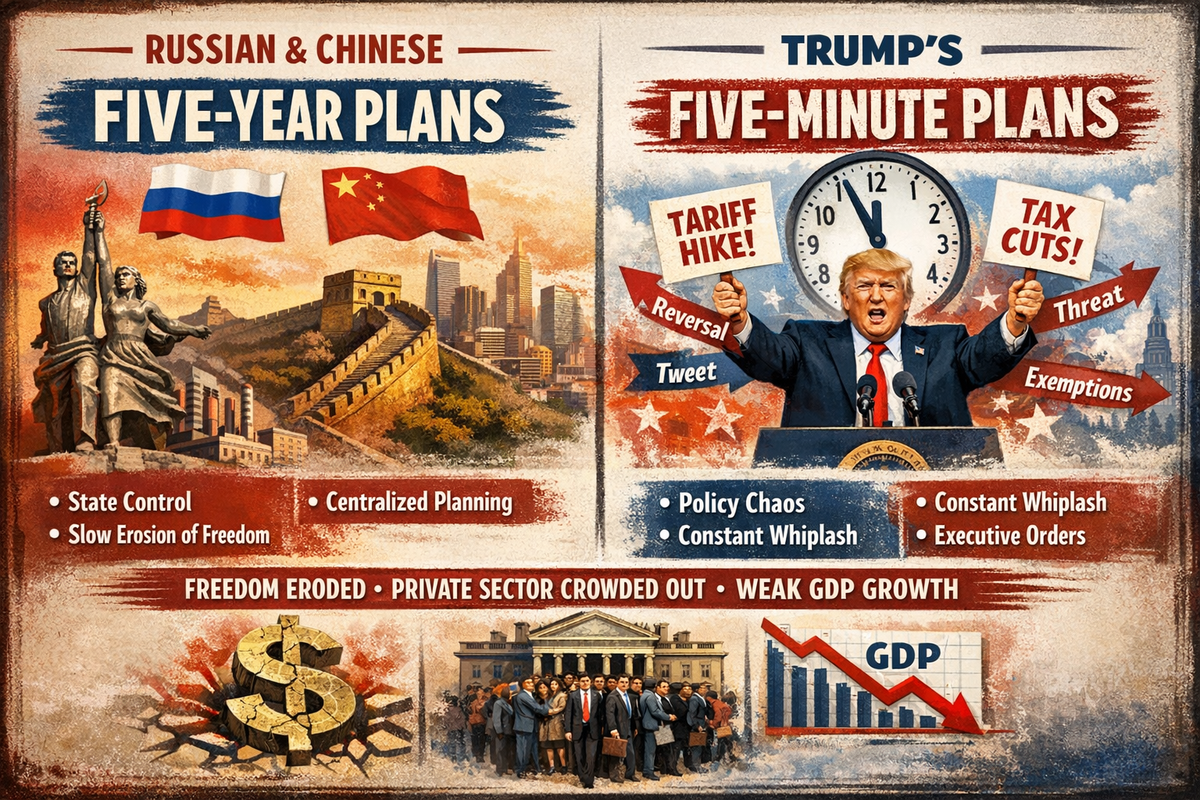
There are two very different ways modern states try to “steer” an economy:
- The long-horizon, centrally directed plan (the classic “Five-Year Plan” model).
- The short-horizon, leader-driven improvisation (the “five-minute plan” vibe: announce, reverse, exempt, threaten, repeat).
They look like opposites. One is rigid and bureaucratic; the other is chaotic and personalistic. But both can converge on similar outcomes: higher volatility, less economic freedom, private-sector crowding out, and weaker long-run GDP growth—just through different mechanisms.
1) What Five-Year Plans are really for (Russia & China)
China: planning as “industrial policy + governance”
China’s Five-Year Plans aren’t just growth roadmaps; they’re also governance documents—tying economic targets to state capacity, technology priorities, and “security” framing. Official plan materials emphasize strengthening the system of governance and Party leadership as part of development.
If you want a concrete example of how planning links to social control: China’s “national informatization” planning documents explicitly talk about building governance standards and security risk assessment around new technologies—i.e., the digital stack of modern administration.
This matters economically because when “the plan” becomes the umbrella for everything (industry, tech, security, social governance), it becomes easier to justify permissioning: who can operate, where capital can go, which data can move, what speech is “harmful,” which sectors get throttled or favored.
Russia: planning as “national goals” plus state-led mobilization
Russia’s modern equivalent isn’t always branded as a Five-Year Plan, but the logic is similar: national targets and priority “projects” set from the center, with implementation routed through the state apparatus. Putin’s decree on national development goals through 2030 (and beyond) is a clear example of this strategic planning architecture.
In both systems, the plan is not merely about efficiency; it’s about control and coordination. That can produce big pushes in targeted sectors—but it can also harden into a political economy where the safest business model is being adjacent to the state.
2) The “Five-Minute Plan” model: volatility as policy
Now jump to the opposite extreme: policymaking that behaves like a live feed.
Instead of “Here is the five-year industrial strategy,” it’s:
“Here is today’s tariff. Tomorrow’s exemption. Next week’s threat. Later, a court challenge.”
Recent coverage shows markets pricing in major uncertainty around tariffs imposed using emergency powers—uncertainty large enough that investors are gaming potential refunds and legal outcomes, with volatility risk in both directions.
This style of governance doesn’t just create uncertainty—it manufactures it as a feature. Even when individual decisions are pro-growth, the meta-signal to firms is: rules can change fast, for opaque reasons, without durable process.
Economists and institutions that track policy uncertainty treat trade shocks and tariff uncertainty as a recurring driver of weaker investment and growth.
So while a Five-Year Plan can crowd out the private sector by over-planning, a Five-Minute Plan can crowd it out by over-randomizing.
3) Two paths to private-sector crowding out
A) Crowding out via directed credit, state champions, and “strategic alignment” (plan-heavy systems)
In plan-led models, private firms can thrive—but often on terms set by the plan: align with priority sectors, accept tighter data controls, share ownership, share governance, accept “guidance.”
Even when governments claim they want more private investment, it often shows up as private capital invited into projects normally led by state firms, with caps/structures that keep the commanding heights public.
China’s recent effort to bolster the private sector with a “Private Economy Promotion Law” signals an official desire to restore confidence—but Reuters also noted the divergence between private and state investment growth rates in the period discussed, illustrating the underlying imbalance planners are trying to correct.
Translation: the state can say “we support private business,” while the system still nudges resources toward state priorities—because that’s what the plan is designed to do.
B) Crowding out via uncertainty, reversals, and compliance overhead (improvisational systems)
In Five-Minute Plan governance, businesses don’t necessarily fear nationalization. They fear whiplash.
When firms can’t predict market access, tariff rates, licensing rules, enforcement priorities, or who gets an exemption, they respond rationally:
- delay investment
- shorten planning horizons
- hold more cash
- re-route supply chains inefficiently
- spend more on lobbying and legal defense than on R&D
That is a form of crowding out too: not by state ownership, but by state unpredictability taxing private planning.
4) Freedom erosion: slow-bake vs jump-scare
Both models can erode freedom, but with different rhythms.
The Five-Year Plan: slow-bake normalization
Because the plan is long and comprehensive, restrictions can be framed as “standards,” “harmonization,” “security,” “risk management,” “governance modernization.” Over time, more of life becomes legible—and controllable—through the plan’s categories.
The Five-Minute Plan: jump-scare executive discretion
Here freedom erodes via precedent: emergency rationales, executive improvisation, enforcement by announcement, and policy made faster than democratic correction. The uncertainty around emergency tariff authority being tested at the Supreme Court is exactly the kind of institutional stress point that makes markets (and civil society) realize how much hinges on discretionary power.
In both cases, the private sector learns the same lesson: don’t bet on stable rules—bet on proximity to power.
5) GDP growth: why both models can disappoint over time
Plan-heavy systems: misallocation risk
Five-Year Plans can generate impressive mobilization—especially when starting from underdevelopment or when pushing infrastructure or specific industries. But the long-run risk is misallocation: capital goes where the plan says, not where marginal returns are highest.
If the plan also tightens governance and expands “security” logic into the economy, you can wind up with a high-investment, lower-dynamism equilibrium: growth continues, but productivity growth slows.
Improvisational systems: investment penalty
Five-Minute Plans punish long-term investment directly. Even if the intent is to “win better deals” or “protect industry,” the mechanism is uncertainty—and uncertainty is gasoline on the fire of risk premiums.
Research and commentary on tariff shocks repeatedly emphasizes how uncertainty around trade policy can weigh on investment and growth.
A practical takeaway: the “freedom-to-plan” test
If you want a simple yardstick for economic freedom and growth prospects, ask:
Can an ordinary firm plan 3–5 years ahead without needing political insurance?
- In a plan-heavy system, the answer depends on whether your business aligns with state priorities.
- In a Five-Minute system, the answer depends on whether you can survive volatility (or secure exemptions).
When the answer is “not really,” you get:
- more rent-seeking
- less entrepreneurship
- lower productivity growth
- and a creeping sense that prosperity is permissioned
That’s how you end up with two very different “planning” cultures producing a surprisingly similar destination.
ChatGPT 5.2 (20260109)
Blog post comparing russian and chinese 5 year plans with Trump's "5 minute plans", focusing on the volatility and long term freedom erosion, private sector crowding out and GDP growth